

Commanding the Market Narrative: Leveraging Proprietary Research to Anchor Vimeo’s Enterprise GTM
Executive Summary
In 2025, enterprise video quietly crossed a threshold.
What was once a marketing-led medium expanded across onboarding, internal communications, sales enablement, learning and development, customer support, and executive messaging. Enterprises were producing more video than ever—while struggling to govern it, scale it, extract insight from it, and connect it to broader business strategy.
Rather than respond with product-led messaging, I led the creation of Vimeo’s 2025 State of Video at Work report, a global research initiative based on insights from 1,000 enterprise leaders. The report was designed to do more than generate awareness.
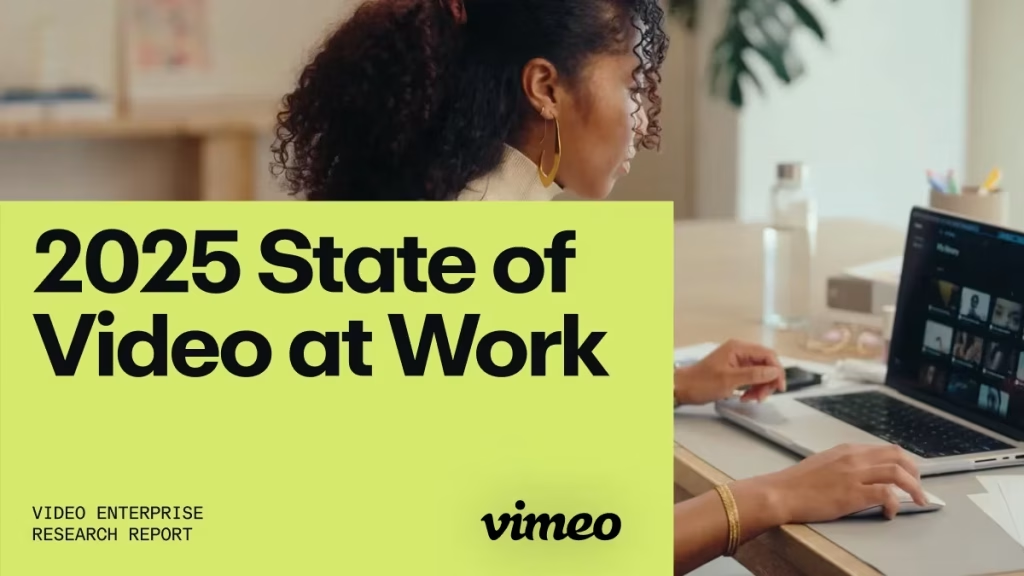
It became the narrative foundation for Vimeo Enterprise — aligning brand, product, and go-to-market teams around a shared, evidence-based understanding of how video was evolving inside large organizations.
The campaign was developed to be a compounding narrative system. One that shaped market perception, informed product strategy, enabled internal teams, and helped enterprise buyers make sense of complexity before they ever evaluated a vendor.
This work treated content not as output, but as infrastructure.
Over the first half of 2025, the Video at Work campaign generated 350+ MQLs and over $1M in influenced pipeline, while serving as the narrative backbone for Vimeo Enterprise’s brand, product, and go-to-market strategy.
The Challenge
Enterprise video had become mission-critical, but strategically unmanaged.
Across large organizations, video creation was accelerating everywhere at once.
- Marketing teams were producing campaigns and brand content.
- Sales teams were recording calls, demos, and presentations.
- HR and L&D teams were onboarding and training at scale.
- Executives were using video to align teams and reinforce culture.
- Meetings, webinars, and events were increasingly recorded by default.

The result was not just more content. It was more complexity.
Enterprises were dealing with:
- Multiple disconnected video platforms across departments and regions
- Rising costs driven by duplicated tooling and overlapping capabilities
- Inconsistent security, compliance, and governance standards
- Limited visibility into performance, engagement, or insight
- No shared definition of what an enterprise video strategy actually was
Externally, the market conversation hadn’t caught up to this reality. Video was still framed as a format, a channel, or a creative asset, not as an enterprise capability that required coordination, governance, and long-term strategy.

Internally, Vimeo faced a parallel challenge. Brand, product, and go-to-market teams all understood pieces of the problem, but lacked a single narrative to align around.
Without shared language, it was difficult to explain why video felt harder every year and why enterprises needed to rethink how they approached it.
The opportunity wasn’t to describe Vimeo’s platform more clearly.
It was to define the problems the market was already living with and paint a picture of the future, where enterprises could turn these challenges into a competitive differentiator.
Defining the Narrative
The decision to lead with original research was deliberate.
Rather than publishing opinionated thought leadership or feature-driven messaging, we designed the 2025 State of Video at Work to surface empirical truth.
By surveying 1,000 senior enterprise leaders across industries, regions, and functions, we could identify patterns that transcended individual use cases.

The research revealed a consistent tension:
- Enterprises overwhelmingly believe video improves business outcomes
- Yet fewer than half have an organization-wide video strategy
- Platform fragmentation is the norm, not the exception
- Security, compliance, and operational risk increase as video scales
- Leaders see untapped value in video data, but lack systems to extract insight
Video is no longer a tool. It’s an enterprise system. Systems require strategy, governance, and infrastructure.
This framing reframed the entire category. The conversation moved away from why video matters toward how video scales—and what breaks when it doesn’t.
It gave buyers language to articulate internal challenges they already felt but struggled to name.
Importantly, this narrative wasn’t about Vimeo. It was about the reality enterprises were facing. That neutrality gave it credibility and allowed Vimeo to lead the category without centering itself as the hero.
Turning the Story Into a System
From the outset, the report was designed not as a moment, but as a system.
Rather than treating the research as a single launch asset, we structured it as a modular narrative architecture that could be expressed consistently across formats, audiences, and stages of the buyer journey.

Each core insight became a reusable narrative pillar that informed:
- Enterprise brand positioning and messaging
- Product storytelling and roadmap articulation
- Sales enablement and early-stage enterprise conversations
- Blogs, videos, webinars, email campaigns, and social content
- Event programming, executive talks, and keynote framing

Crucially, we resisted the temptation to reinvent the story for novelty’s sake. The same core ideas were reinforced repeatedly, translated for context, not rewritten.
This ensured clarity, consistency, and compounding impact over time.
By treating the narrative as infrastructure, Vimeo was able to scale its enterprise presence without fragmenting its message or diluting its point of view.
Engineering Discovery
Enterprise buying rarely begins with a shortlist. It begins with sense-making.
The research-led narrative allowed Vimeo to show up early (before intent) by helping leaders articulate questions they were already asking internally:
- Why does video feel harder to manage every year?
- Why are insights trapped inside content we rely on daily?
- Why does governance lag creation at scale?
Because the State of Video at Work addressed category-level challenges rather than product features, it became a trusted reference point.
It supported early education, internal alignment within buying groups, and executive justification for modernization efforts.

Discovery wasn’t engineered through clicks or campaigns.
It was earned by helping the market understand itself more clearly.
To ensure the narrative scaled inside the organization, we operationalized it through:
- A centralized, filterable Enterprise Content Library
- Sales and Customer Success enablement delivered via Seismic
- Company-wide enablement through Vimeo’s intranet, The Loop
- A simplified narrative and key findings document used as a shared source of truth

Activating Belief
Belief emerged when insight turned into architecture—and architecture turned into innovation.
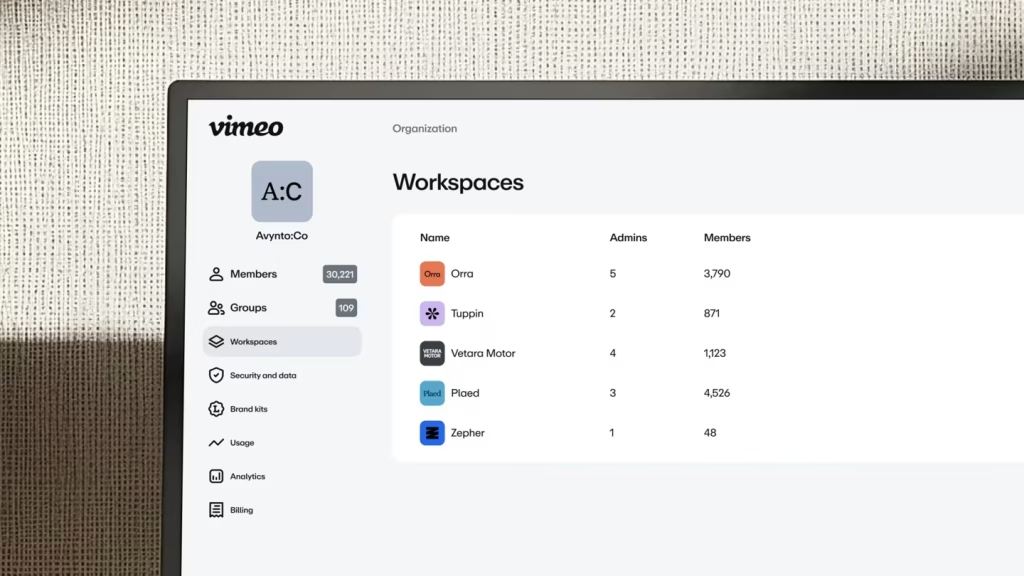
Midway through the year, the narrative evolved from diagnosis to design with the launch of Vimeo Workspaces.
Building directly on the research, I led the development of a follow-on ebook focused on Enterprise Video Orchestration.
The research had made one thing clear: fragmentation wasn’t accidental. It was structural. Enterprises needed centralized governance and local autonomy. Most platforms forced a false tradeoff between control and flexibility.
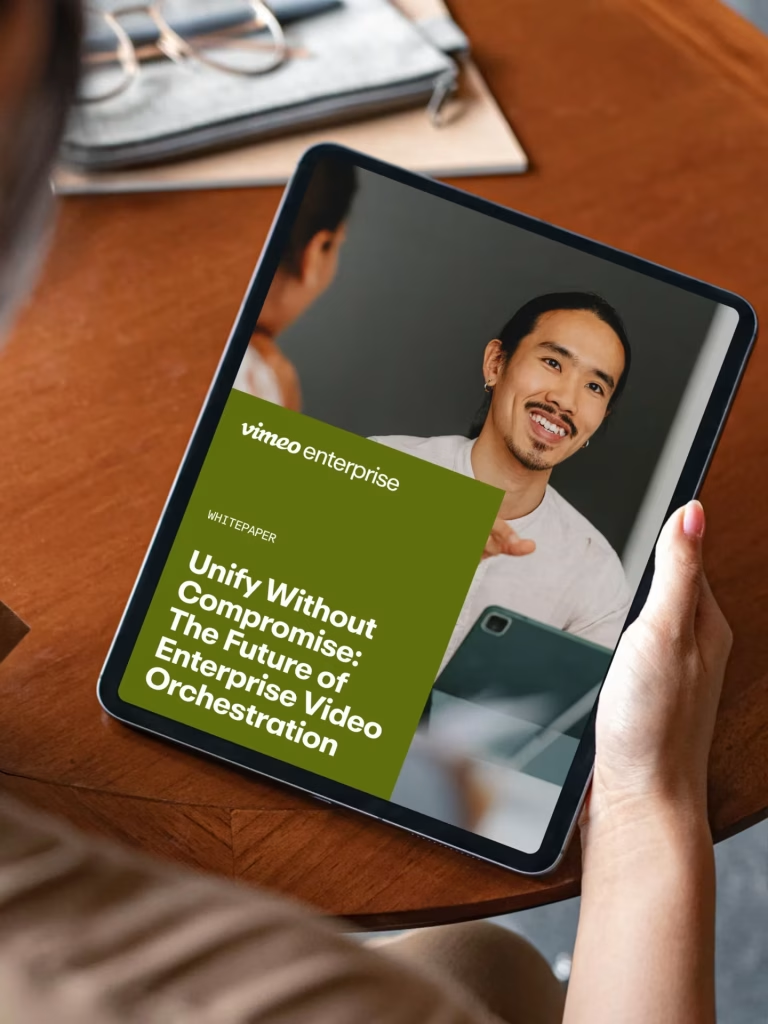
The Workspaces narrative reframed video as an orchestrated system that could unify platforms across brands, regions, and teams while preserving independence where it mattered. Because this story was grounded in previously established insight, the product felt like a logical response rather than a new direction.
That arc continued at REFRAME 2025 with the announcement of Agentic AI. The original research had revealed a gap between belief and execution around extracting insights from video.

Agentic AI directly addressed that gap—showing how unified infrastructure enables automated insight extraction, smarter workflows, and data-driven decision-making at scale.
Because the story had been told in stages: research → orchestration → AI, innovation felt credible and inevitable.
Impact & What Changed
The 2025 State of Video at Work became the connective tissue for Vimeo Enterprise.
Externally, the narrative reshaped how enterprise video was understood:
- Established a clear, category-level point of view on enterprise video at scale
- Shifted the conversation from isolated tools to systems, strategy, and orchestration
- Positioned Vimeo as a guide through complexity, rather than a feature-led vendor
- Served as pre-demand education that helped buying groups make sense of change before evaluation
Over the first half of 2025, the Video at Work campaign generated 350+ MQLs and over $1M in influenced pipeline, validating that research-led storytelling can drive both clarity and commercial impact.

Internally, the work created alignment across the organization:
- Unified brand, product, and go-to-market teams around a shared, evidence-based narrative
- Powered a year-long, multi-format content system that scaled without fragmenting the story
- Informed product storytelling and roadmap communication across enterprise initiatives
- Strengthened early-stage enterprise sales conversations by anchoring them in shared truth
Most importantly, this work demonstrated a repeatable model for Vimeo Enterprise storytelling—one that connects insight to execution and narrative to innovation:
Insight creates clarity.
Clarity creates alignment.
Alignment makes innovation believable.
That model didn’t just shape a campaign.
It shaped how Vimeo showed up in the enterprise market and how the organization aligned behind what came next.